Blog
Email marketing notes.
Email Marketing
How to Build an Ecommerce Email Marketing Strategy From Scratch
Create an ecommerce email marketing strategy from scratch with list growth, segmentation, core flows, campaigns, and metrics.
By Peak Meadow Published July 7, 2026
Email remains one of the highest-ROI channels in ecommerce, yet many brands approach it without a clear system. A strong ecommerce email marketing strategy is not just about sending promotions, it is about building a structured engine that captures leads, nurtures relationships, and drives consistent revenue.
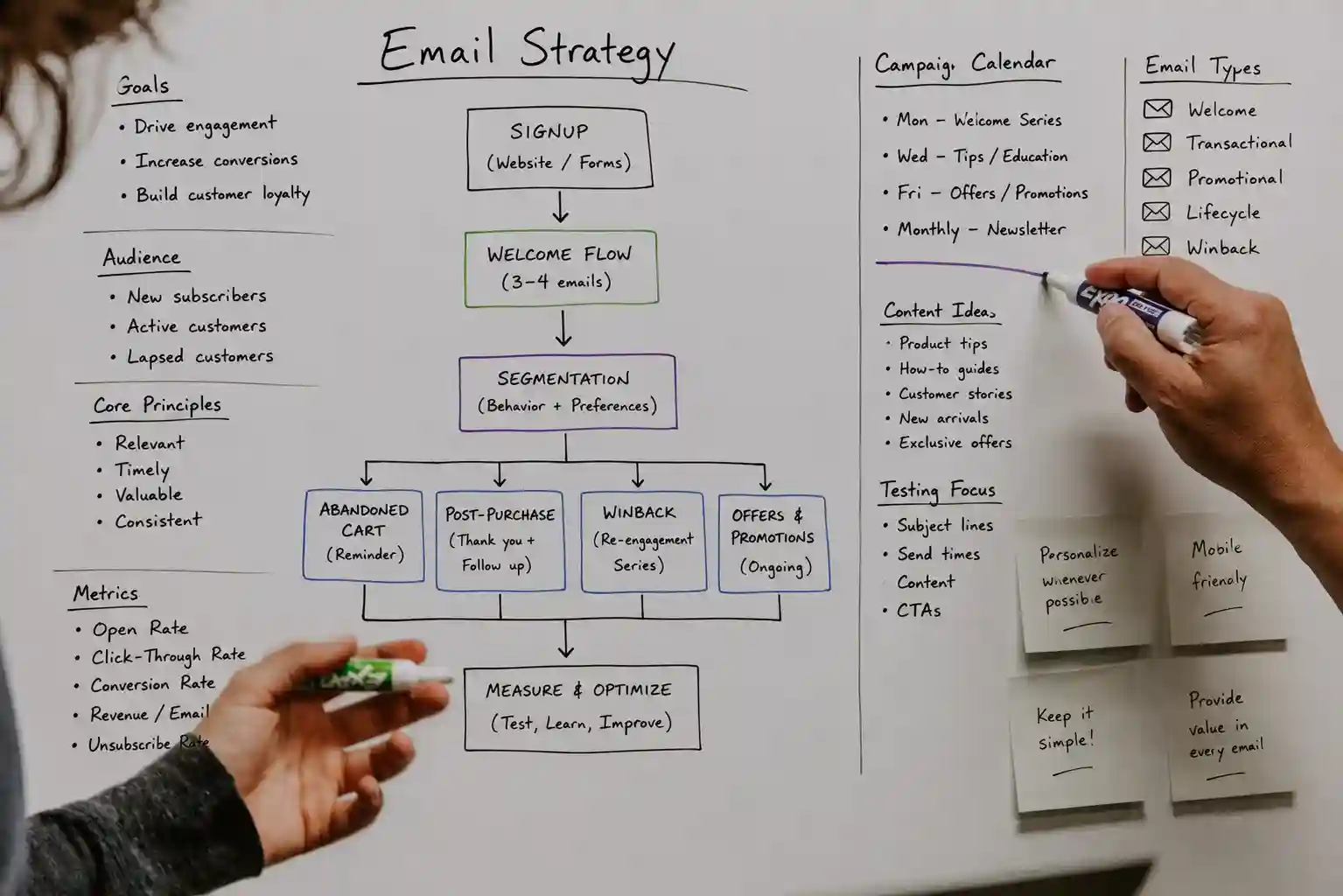
If you are starting from zero, the process can feel overwhelming. The good news is that a high-performing ecommerce email strategy can be broken down into five core components: list, segments, flows, campaigns, and metrics. Master these, and you will have a scalable foundation that grows with your business.
This guide walks through exactly how to start ecommerce email marketing step by step; with practical insights you can apply immediately.
Step 1: Build Your Email List
Your email list is the foundation of your ecommerce email marketing strategy. Without a steady flow of subscribers, nothing else matters.
The goal is not just to collect emails, but to attract the right subscribers. People who are genuinely interested in your products and would like to stay in the loop about whatever you are promoting.
Start with these core list-building methods:
- Website popups: Use exit-intent, timed, and scroll-based popups offering a discount or incentive (e.g., 10 percent off).
- Embedded forms: Place signup forms in your footer, blog posts, and product pages.
- Checkout opt-ins: Ensure customers can easily subscribe during purchase.
- Landing pages: Create dedicated pages for promotions or lead magnets.
- Social media traffic: Drive followers to signup pages using exclusive offers.
The key is to offer value. Discounts work well, but consider other incentives such as early access, exclusive content, or loyalty perks.
An example is a skincare brand offering a “Personalized Routine Quiz” in exchange for an email address. This not only builds the list but also gathers data for segmentation later.
Avoid buying email lists. It harms deliverability, violates best practices, and ultimately reduces performance.
Step 2: Segment Your Audience
Once you start collecting emails, the next step in your ecommerce email strategy is segmentation. Sending the same message to everyone limits engagement and revenue.
Segmentation allows you to send more relevant, personalized emails based on behavior and characteristics.
Start with these foundational segments:
- New subscribers
- Engaged subscribers
- Unengaged subscribers
- Customers vs. non-customers
- Repeat customers
- Cart abandoners
- Browsers
As your data grows, you can build more advanced segments using:
- Purchase frequency
- Average order value
- Product categories viewed or purchased
- Time since last purchase
Here’s an example, if someone frequently buys fitness gear, sending them emails about supplements or workout programs will likely outperform generic promotions.
Segmentation is where your ecommerce email marketing strategy starts to become truly powerful. It ensures that every email feels relevant instead of intrusive.
Step 3: Set Up Core Email Flows
Flows (also called automations) are the backbone of how to start ecommerce email marketing effectively. These are triggered emails that run automatically based on user behavior.
They generate consistent revenue without requiring manual effort once set up. It’s estimated that around 41% of all ecommerce sales are driven by automated flows in the modern day.
Here are the essential flows every ecommerce brand should implement

Welcome Series
This is the first impression of your brand. It should introduce your value, build trust, and guide subscribers toward their first purchase.
A typical structure includes:
- Email 1: Welcome and incentive delivery
- Email 2: Brand story and differentiation
- Email 3: Product highlights or bestsellers
- Email 4: Social proof and reviews
- Email 5: Urgency or reminder to use discount
Abandoned Cart Flow
One of the highest-converting automations. These emails remind users to complete their purchase.
Best practices include:
- Send the first email within 1-2 hours
- Include product images and clear CTAs
- Add urgency (limited stock, time-sensitive offers)
- Consider a discount in later emails
Browse Abandonment Flow
Targets users who viewed products but did not add to cart. This is an often-overlooked flow that can pay off big-time. Sometimes, all a customer needs is a little nudge in order to continue on their purchasing journey.
Post-Purchase Flow
Once the sale is made, our job is not finished. Now, it becomes time to focus on retention and customer experience. The reason for this is simple: it’s cheaper to get a customer to purchase from us again rather than getting an entirely new customer. What you should include is:
- Order confirmation and shipping updates
- Product usage tips
- Cross-sell recommendations
- Review requests
Win-back Flow
Re-engage inactive customers after a certain period (e.g., 60-90 days).
Offer incentives, highlight new products, or ask for feedback.
Example: A clothing brand uses a win-back campaign offering “We miss you, here’s 20 percent off your next order,” resulting in a measurable lift in returning customers.
Flows should be prioritized before campaigns because they provide consistent baseline revenue.
Step 4: Plan and Execute Campaigns
While flows run automatically, campaigns are sent to specific segments. These are essential for promotions, product launches, and brand storytelling.
A balanced ecommerce email marketing strategy includes both.
Common campaign types include:
- Promotional campaigns
- Product launches
- Seasonal campaigns
- Content-driven emails
- Loyalty campaigns
The key is to avoid over-sending generic promotions. Instead, align campaigns with your segmentation strategy.
Example: Instead of blasting a sitewide sale to everyone, send:
- VIP customers early access
- First-time buyers a stronger incentive
- Browser reminders of specific products they viewed
Frequency matters. Too few emails and you miss opportunities; too many and you risk unsubscribes.
A good starting point is:
- 1-2 campaigns per week
- Adjust based on engagement and performance
Consistency is more important than volume. Build a predictable rhythm so subscribers know what to expect.
Step 5: Track Metrics and Optimize
No ecommerce email strategy is complete without measurement. Tracking performance helps you understand what works and where to improve.
Focus on these core metrics:
- Open rate
- Click-through rate (CTR)
- Conversion rate
- Revenue per recipient (RPR)
- Unsubscribe rate
- Spam complaints
Beyond individual metrics, look at overall contribution:
- Percentage of total revenue driven by email
- Performance of flows vs. campaigns
- Segment-level engagement
If your abandoned cart flow generates 25 percent of your email revenue, investing time in optimizing it can significantly boost results.
Optimization should be ongoing. Test variables such as:
- Subject lines
- Send times
- Email design
- Call-to-action placement
- Offers and incentives
Even small improvements can compound over time.
Bringing It All Together
A successful ecommerce email marketing strategy is not built overnight. It is a system that evolves through consistent execution and optimization.
Here is how the pieces connect:
- Your list fuels everything
- Segmentation ensures relevance
- Flows drive automated revenue
- Campaigns create spikes in engagement and sales
- Metrics guide continuous improvement
When these components work together, email becomes more than a marketing channel. It becomes a predictable revenue engine.
Common Mistakes to Avoid
As you build your ecommerce email strategy, watch out for these common pitfalls:
- Sending too many generic emails without segmentation
- Ignoring automations and relying only on campaigns
- Focusing only on discounts instead of brand value
- Neglecting list growth efforts
- Failing to analyze and act on performance data
Avoiding these mistakes can accelerate your results and prevent wasted effort.
Final Thoughts
If you are wondering how to start ecommerce email marketing, the answer is not complicated, but it does require structure.
You should focus on building a quality list, segmenting your audience, implementing high-impact flows, running thoughtful campaigns, and tracking the right metrics.
Start simple. You don’t need to have everything planned out or executing at high levels to get started. Afterwards, execute consistently, and refine over time. That is how a basic setup turns into a high-performing ecommerce email marketing strategy that drives long-term growth.