
Blog
Email marketing notes.
Email Marketing
Best Email Marketing Software for Ecommerce
Compare the best ecommerce email marketing software by integrations, automation, segmentation, reporting, pricing model, and fit for your store.
By Peak Meadow Published August 30, 2026
Best Email Marketing Software for Ecommerce
The best email marketing platform for ecommerce is the one that connects cleanly to your store, uses purchase behavior for segmentation, supports automated flows, tracks revenue, and gives your team enough control without slowing them down. Those capabilities are the foundation of a broader ecommerce email marketing program.
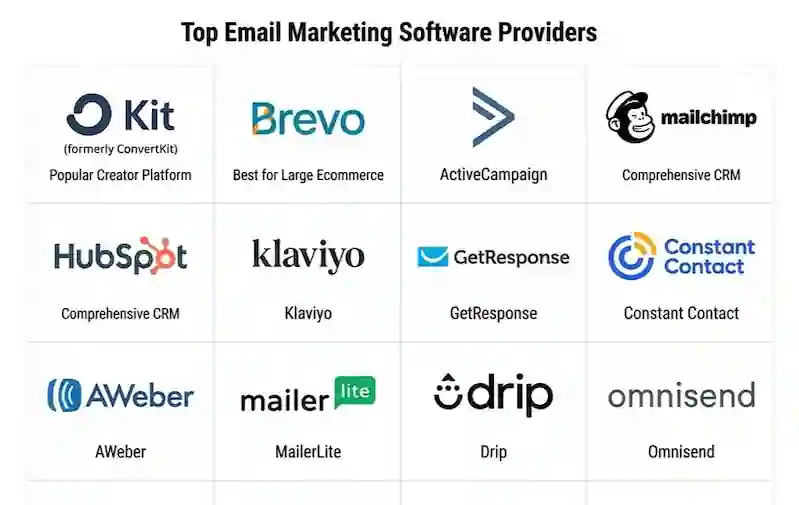
For many growing Shopify and direct-to-consumer brands, Klaviyo is the strongest overall choice. Omnisend is a strong option for brands that want email, SMS, and push notifications in one place. Shopify Messaging (formerly Shopify Email) is the simplest starting point for smaller Shopify stores that want email and other messaging inside Shopify. Mailchimp, ActiveCampaign, Brevo, Constant Contact, and HubSpot can also make sense depending on your budget, store platform, team, and automation needs.
There isn’t one perfect ecommerce email service provider (ESP) for every store. A brand selling replenishable skincare products needs different tools than a small apparel store that sends one campaign per week. A WooCommerce merchant may prioritize plugin reliability, while a Shopify Plus brand may care more about segmentation depth, attribution, and lifecycle automation.
This guide will help you compare the best email marketing software for ecommerce without burying you in feature lists.
Quick Comparison: Best Ecommerce Email Platforms
Use this table as a starting point for your research. The details matter, but this gives you the basic information about the current state of the market.
| Platform | Best for | Main strength | Watch out for |
|---|---|---|---|
| Klaviyo | Growing Shopify and DTC brands | Deep ecommerce data, segmentation, and automation | Can feel expensive or complex for very small stores |
| Omnisend | Brands that want email, SMS, and push | Omnichannel workflows built for ecommerce | Advanced teams may still prefer Klaviyo’s data depth |
| Shopify Messaging | Small Shopify stores | Easy setup inside Shopify | Less flexible than dedicated ESPs |
| Mailchimp | Simple ecommerce newsletters | Ease of use and broad brand familiarity | Ecommerce automation is less specialized than Klaviyo or Omnisend |
| ActiveCampaign | Stores with complex customer journeys | Automation depth and CRM-style workflows | Can take more planning to set up well |
| Constant Contact | Small businesses that also sell online | Approachable campaigns, integrations, and automation | Advanced ecommerce automation may require a higher plan |
| Brevo | Budget-conscious stores | Email, SMS, and CRM features at accessible pricing | Ecommerce-specific depth may vary by use case |
| HubSpot | CRM-led ecommerce teams | CRM, sales, service, and marketing in one system | Often more than a simple store needs |
What Ecommerce Stores Need From an Email Platform
Regular email tools can send newsletters. Ecommerce email platforms need to do more than that.
An online store needs software that can understand what shoppers do before and after they buy. That includes browsing products, adding items to cart, starting checkout, purchasing, buying again, using a discount, joining SMS, leaving a review, or going quiet for months.
At a minimum, the best ecommerce email software should include:
- Native or reliable integration with your ecommerce platform
- Automated flows for welcome, abandoned cart, browse abandonment, post-purchase, and win-back emails
- Segmentation based on purchases, products viewed, engagement, location, value, and lifecycle stage
- Revenue reporting tied to campaigns and automations
- Product blocks, discount code support, and dynamic product recommendations
- Signup forms and popups
- Deliverability tools and suppression list management
- A/B testing for subject lines, content, timing, and offers
- Support for SMS if your brand plans to use it
The real value comes from the connection between customer data and messaging. If your ESP can’t use store behavior to send more relevant emails, it may be fine for newsletters, but it won’t support a serious ecommerce retention program.
Why the Platform Choice Matters
The platform choice matters because ecommerce email depends on timely store data. If product views, carts, orders, consent status, and catalog changes do not sync cleanly, even good strategy becomes hard to execute.
Klaviyo’s 2026 email benchmarks, based on more than 183,000 Klaviyo customers, found that automated flows generated nearly 41% of email revenue from 5.3% of sends. That is vendor-platform data rather than a universal market benchmark, but it shows why reliable triggers, exclusions, and ecommerce events deserve more weight than a long template list.
1. Klaviyo
Klaviyo is often the best email marketing platform for ecommerce brands that are serious about lifecycle marketing. It is especially common among Shopify, Shopify Plus, and direct-to-consumer brands.
Its main strength is customer data. Klaviyo is built around profiles, events, predictive analytics, segments, and flows. That makes it easier to create targeted automations based on what people bought, viewed, clicked, ignored, or are likely to do next.
Klaviyo is a strong fit if you want to build flows like:
- Welcome series
- Abandoned cart
- Browse abandonment
- Post-purchase education
- Product replenishment
- Review request
- Cross-sell and upsell
- Win-back
- VIP and loyalty
- Back-in-stock alerts
Klaviyo also supports email, SMS, mobile push, reviews, segmentation, product recommendations, and detailed reporting. Its Shopify integration guide explains how customer profiles, orders, consent data, catalog data, and onsite events can sync into Klaviyo, which can shorten setup for teams that do not want to build every automation from a blank page.
You should choose Klaviyo if you want a platform that can grow into a more advanced email program. It is not always the cheapest option, and a very small store may not need all of its depth on day one. For stores that care about segmentation, automation, and revenue reporting, however, Klaviyo should be one of the first tools to evaluate.
2. Omnisend
Omnisend is one of the strongest Klaviyo alternatives for ecommerce brands, especially if you want email, SMS, and web push notifications in one platform. Our Omnisend vs. Klaviyo comparison covers the tradeoffs directly.
Its feature set is clearly built around ecommerce. Omnisend includes campaigns, automations, segmentation, forms, popups, reports, SMS, push notifications, product blocks, discount code blocks, and behavior-based triggers. Its current integration documentation lists native connections for Shopify, BigCommerce, WooCommerce, WordPress, Wix, Shoplazza, and several other platforms, plus an API route for custom stores.
Omnisend is a good fit for brands that want:
- A clean campaign builder
- Prebuilt ecommerce automations
- Email, SMS, and push notifications in one workflow
- Simple list growth tools
- Product-focused email blocks
- Strong value for small and mid-sized stores
Omnisend can be especially useful for teams that want broad channel mix without the complexity of managing several separate tools. For example, a cart recovery sequence could use email first, SMS later, and push for shoppers who opted into browser notifications.
You should choose Omnisend if you want an ecommerce-first platform that feels practical, clear, and more omnichannel out of the box.
3. Shopify Messaging
Shopify Messaging, formerly Shopify Email, is best for smaller Shopify stores that want to send branded marketing messages without adding another full ESP.
Its main advantage is simplicity. It works inside Shopify, pulls in store data, supports templates, uses Shopify customer segments, and lets merchants create campaigns without a separate platform. Shopify Messaging supports campaigns and marketing automations inside the Shopify admin, while Shopify Flow can handle custom workflows.
For a newer store, that can be enough. You can build a basic list, send product campaigns, set up simple automations, and keep everything close to the store admin.
Shopify Messaging is a good fit when:
- You’re already on Shopify
- You have a small list
- You send simple campaigns
- You don’t need advanced segmentation yet
- You want to avoid extra software during the early stage
The biggest limitation is depth. Shopify Messaging isn’t usually the best choice for brands that need advanced flows, more detailed testing, richer reporting, or complex lifecycle segmentation. Many stores begin with Shopify Messaging and later move to Klaviyo, Omnisend, or another dedicated ESP when email becomes a bigger revenue channel.
4. Mailchimp
Mailchimp is a familiar option for small businesses and ecommerce stores that want an easy way to send campaigns, build forms, and manage basic marketing automation. Stores comparing it with a creator-focused platform can also review Kit vs. Mailchimp.
Mailchimp can connect to ecommerce stores, including Shopify, through Mailchimp for Shopify. Its Shopify integration documentation says it syncs customer and order data, supports targeted ecommerce email and SMS, tracks performance, and can generate product recommendations.
Mailchimp is a good fit if:
- You want a simple email tool
- Your store mostly sends newsletters and promotions
- You don’t need deep ecommerce segmentation
- Your team already knows Mailchimp
- You want broad marketing features beyond ecommerce email
Mailchimp’s main tradeoff is specialization. It can work for ecommerce, but it isn’t as ecommerce-native as Klaviyo or Omnisend. If you plan to build a serious retention system with detailed flows, product behavior, predictive segments, and revenue reporting, compare it carefully before committing.
Mailchimp can be a reasonable starting point. It may not be the best long-term platform for a growing ecommerce brand.
5. ActiveCampaign
ActiveCampaign is a strong choice for stores that need advanced automation and CRM-style customer journeys. If Mailchimp is also on your shortlist, the ActiveCampaign vs. Mailchimp comparison makes that decision more specific.
Its ecommerce features support integrations with Shopify, WooCommerce, Magento, and other Deep Data integrations. ActiveCampaign’s abandoned cart documentation explains which integrations support the trigger and abandoned product content.
ActiveCampaign is a good fit if your email program has logic like:
- Different paths for leads, customers, and repeat customers
- Sales team follow-up
- Customer health or lead scoring
- Complex tagging
- Longer buying cycles
- Education sequences before a purchase
- Ecommerce plus B2B or service-based selling
ActiveCampaign may be more platform than a simple ecommerce store needs. But if your business blends ecommerce with sales, appointments, subscriptions, courses, wholesale, or a more complex CRM process, ActiveCampaign deserves a close look. Existing users can also learn how to see all activities in ActiveCampaign before judging what their current setup can do.
6. Constant Contact
Constant Contact is a general small-business marketing platform with useful ecommerce integrations, rather than an ecommerce-first ESP in the same mold as Klaviyo or Omnisend.
Constant Contact’s ecommerce product page lists integrations with Shopify, WooCommerce, Wix, and Squarespace, along with product blocks, segmentation, reporting, and automations such as cart reminders, post-purchase, and win-back. Several advanced automation and segmentation features are plan-dependent, so confirm the tier you need before buying.
Constant Contact is a good fit when you need:
- An approachable campaign builder and live support
- A connection to Shopify, WooCommerce, Wix, or Squarespace
- Core ecommerce automation and revenue reporting on the appropriate plan
- Broader small-business marketing or event tools alongside email
It’s worth comparing against Klaviyo and Omnisend. Some teams prefer Constant Contact’s approach to segmentation and workflows while others prefer Klaviyo’s ecosystem or Omnisend’s channel mix.
Choose Constant Contact if you want an approachable small-business marketing suite that can connect to your store and your automation needs fit its available plans.
7. Brevo
Brevo can be a good option for cost-conscious ecommerce brands that want email marketing, SMS, automation, transactional email, and CRM-style features in one place.
It is often considered by smaller teams that need a practical marketing platform but aren’t ready for the cost or complexity of a more ecommerce-specialized ESP.
Brevo could be a better option when:
- Budget matters
- You need both marketing and transactional email
- You want SMS available
- Your automations are useful but not highly complex
- You prefer a broad marketing tool over a niche ecommerce ESP
The tradeoff is that Brevo may not feel as purpose-built for ecommerce as Klaviyo, Omnisend, or Constant Contact. If your store needs deep product behavior, advanced ecommerce segmentation, and detailed revenue attribution, test the integration carefully before making it your main platform.
8. HubSpot
HubSpot is best for ecommerce businesses that want email marketing connected to a broader customer relationship management (CRM), sales, service, and reporting system.
For an online store just starting out or one that doesn’t need extra features, HubSpot may be more than you need. But it can make sense for brands with sales teams, high-ticket products, B2B ecommerce, wholesale programs, customer service pipelines, or content-heavy lead nurturing.
Here’s when it might make sense to use HubSpot:
- Having a CRM is central to your business
- Sales and marketing alignment are integral
- Your products have a longer consideration cycle
- You need, or want, content, email, forms, CRM, and reporting all working together
- Your customer journey extends beyond a normal online checkout
For pure DTC ecommerce, compare HubSpot carefully against ecommerce-first platforms. HubSpot’s strength is the larger customer platform. That means it’s not always the most specialized when it comes to having ecommerce email features.
How to Choose the Best Email Marketing Platform for Ecommerce
Before you compare demos or pricing pages, define what your store needs from email. The right platform depends on your business model; only then should you compare feature lists.
1. Start With Your Store Platform
Your ESP should connect cleanly to your ecommerce platform.
If you’re on Shopify, then Klaviyo, Omnisend, Shopify Messaging, Mailchimp, Constant Contact, ActiveCampaign, and others are all possible options. If you’re on WooCommerce, pay close attention to plugin quality, data sync, abandoned cart tracking, and product catalog support. For BigCommerce, Magento, or a custom store, integration depth matters even more.
Weak integration creates problems later. You may lose important triggers, product data, purchase history, or attribution. Test the exact events and fields you need before committing.
2. Match the Platform to Your Email Maturity
Don’t buy more complexity than your team can use.
If you’re just starting, you may need simple campaigns, a welcome flow, abandoned cart emails, and signup forms. Shopify Messaging, Mailchimp, Brevo, or Omnisend could all be enough for that use case.
If email is already a serious revenue channel, you may need advanced segments, conditional splits, predictive data, deeper reporting, and more testing. That’s when Klaviyo, Omnisend, or ActiveCampaign may have the upper hand; Constant Contact can also fit when its higher-tier automation covers your needs.
Put simply, the best platform is the one that you use well.
3. Check the Core Ecommerce Flows
Every ecommerce ESP should help you build the basic lifecycle flows.
At minimum, check whether the platform can handle:
- Welcome series
- Abandoned cart
- Browse abandonment
- Checkout abandonment
- Post-purchase
- Cross-sell
- Replenishment or reorder reminders
- Win-back
- Review requests
- Back-in-stock emails
You may not need all of these on day one; however, the platform should support them as your store grows. You do not want to discover in the middle of peak season that your current platform cannot support a flow you need.
4. Look at Segmentation Depth
Segmentation is where ecommerce email becomes more profitable and less noisy.
Some useful segments that you could apply to your customers:
- New subscribers who haven’t bought yet
- First-time customers
- Repeat customers
- VIP customers
- Discount buyers
- Full-price buyers
- Category buyers
- Product viewers who didn’t purchase
- Cart abandoners
- Customers likely to churn
- Inactive subscribers
If a platform only lets you segment by basic contact fields, it won’t be enough. A serious ecommerce email platform will quickly need more capabilities.
5. Review Reporting and Attribution
Revenue reporting is useful, but attribution can be messy. Different platforms use different attribution windows and rules. That means you shouldn’t treat every dashboard number as perfect truth.
Look for reporting that shows:
- Revenue by campaign
- Revenue by flow
- Placed order rate
- Revenue per recipient
- Click rate
- Unsubscribe rate
- Bounce rate
- Deliverability trends
- Segment performance
- Product performance
Reporting is useful when it helps you make better decisions. Do not treat a flattering attribution dashboard as proof that the program is profitable.
6. Consider Total Cost
The monthly price may look tempting; however, you should consider the total cost.
When making your decision, think about things such as:
- Contact count
- Email send volume
- SMS credits
- Add-ons
- Reviews tools
- Dedicated IP options
- Migration support
- Template design
- Setup help
- Staff time
Time has value. A cheaper platform can become expensive if it takes too much manual work. A more expensive platform can be worth it if it saves time and drives more revenue. Compare costs and make your decision on time savings, monthly pricing, and what your team can reliably handle.
Best Platform by Store Type
These are practical starting points for different types of ecommerce stores:
| Store type | Best starting options |
|---|---|
| Small Shopify store | Shopify Messaging, Omnisend, Mailchimp |
| Growing Shopify DTC brand | Klaviyo, Omnisend |
| WooCommerce store | Klaviyo, Omnisend, ActiveCampaign |
| Email plus SMS program | Omnisend, Klaviyo, Brevo |
| Complex automation needs | ActiveCampaign, Klaviyo |
| Budget-conscious store | Brevo, Mailchimp, Shopify Messaging |
| CRM-led ecommerce business | HubSpot, ActiveCampaign |
| Advanced segmentation needs | Klaviyo, Omnisend, ActiveCampaign |
Your situation may be different. If you’re unsure, decide what matters most: simplicity, ecommerce depth, omnichannel messaging, automation power, CRM, or cost.
Common Mistakes to Avoid
Choosing the wrong platform is usually less about missing one feature and more about picking a tool that doesn’t match the way your business works.
Avoid these common mistakes:
- Choosing based only on price
- Choosing based only on what another brand uses
- Ignoring integration quality
- Overbuying advanced software
- Underbuying a basic tool when email is already a major revenue channel
- Forgetting about SMS costs
- Trusting attribution numbers without understanding the settings
- Migrating without a plan for forms, flows, lists, suppression data, and templates
Teams often underestimate migration. If you’re moving from one ESP to another, document your current flows, export key segments, preserve suppression lists, rebuild forms, test tracking, and warm up sending carefully.
Conclusion
For an ecommerce-first default, put Klaviyo on the shortlist. It is one of the strongest choices for brands that want deep segmentation, automated flows, and revenue reporting.
When you need a strong ecommerce platform with email, SMS, and push in one place, Omnisend might be a better choice.
Small Shopify stores may want the simplest path, which makes Shopify Messaging a compelling option.
Stores with complex automation or CRM requirements should also evaluate ActiveCampaign or HubSpot.
If you want an approachable small-business platform with ecommerce integrations, take a look at Constant Contact.
When budget is the main concern, compare Brevo and Mailchimp against your actual contact count, send volume, and required features.
The best email marketing platform for ecommerce is the one that fits your store data, team, and program—not the one with the longest feature list. Narrow the field to two platforms, connect a test store or account, and verify the events you depend on before signing a long contract. A working cart flow and a trustworthy order report will tell you more than a feature grid.