Blog
Email marketing notes.
Email Marketing
Cart Recovery Email Templates That Convert
Use these cart recovery email templates to bring high-intent shoppers back, with practical advice on timing, incentives, segmentation, and testing.
By Peak Meadow Published August 30, 2026
Cart Recovery Email Templates That Convert
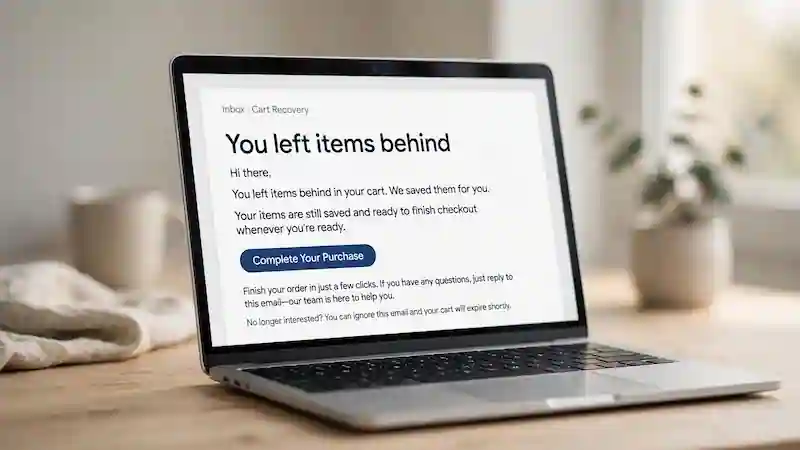
Cart recovery emails reach shoppers at a high-intent moment: they found something they wanted, added it to their cart, and left before finishing the purchase.
That doesn’t always mean they changed their mind. They may have wanted to compare prices. Shipping may have felt too high. They may have gotten distracted and planned to come back later.
The job of a cart recovery email isn’t to beg for the sale. It’s to make returning easy while reducing hesitation and giving the shopper a clear reason to finish.
Baymard Institute’s compilation of 50 cart-abandonment studies, last updated in September 2025, puts the average documented rate at 70.22%. Klaviyo’s 2024 report, based on more than 143,000 abandoned-cart flows sent in 2023, reinforces the importance of abandoned cart flows. It shows a 50.5% average open rate, 6.25% click rate, and 3.33% placed order rate. These are cross-account benchmarks and are not promises for an individual store.
A well-run flow can recover otherwise lost orders, but judge the result by incremental profit after discounts, product costs, and platform fees. Shoppers who leave before adding an item need a lighter browse abandonment flow instead.
The Best Cart Recovery Email Sequence
A simple three-email sequence is a sensible baseline for many ecommerce stores. Add complexity only when your own results justify it.
| Suggested timing | Main angle | Offer | |
|---|---|---|---|
| 1 | 1-3 hours after abandonment | Friendly reminder | None |
| 2 | 18-24 hours later | Benefits, reviews, or objections | Usually none |
| 3 | 36-72 hours later | Final nudge or incentive | Optional |
Don’t lead with a discount unless you need to. If you offer 10% off every time someone leaves a cart, shoppers may learn to wait. Start with relevance and clarity. Use the offer when it has a real purpose.
Before using any template below, make sure your email includes:
- Product image, name, price, size, color, and quantity
- A clear button back to checkout
- Mobile-friendly layout
- Support options in case the shopper has a question
- Trust signals like reviews, returns, guarantees, or shipping details
1. The Simple Reminder Email
This should usually be the first cart recovery email in the sequence. Keep it short. The shopper has already shown interest.
Subject line options that may be used:
- You left something behind
- Still thinking it over?
- Your cart is waiting
These options are short and direct. The goal is a friendly reminder that brings the purchase back to mind.
Here’s a template that I might use:
Hi [First Name],
Looks like you left a few things in your cart.
No pressure, but we saved them so you can pick up right where you left off.
[Cart product block]
[Return to cart]
If you have any questions before ordering, just reply to this email. We’re happy to help.
Why it works: It focuses on convenience. No long pitch, no pressure, and no unnecessary discount.
2. The Product Benefit Email
Some shoppers leave because they haven’t fully convinced themselves the product is worth buying. This email brings the value back into focus.
Subject line options:
- A quick reminder about [Product Name]
- Why customers choose [Product Name]
- Still deciding? This may help
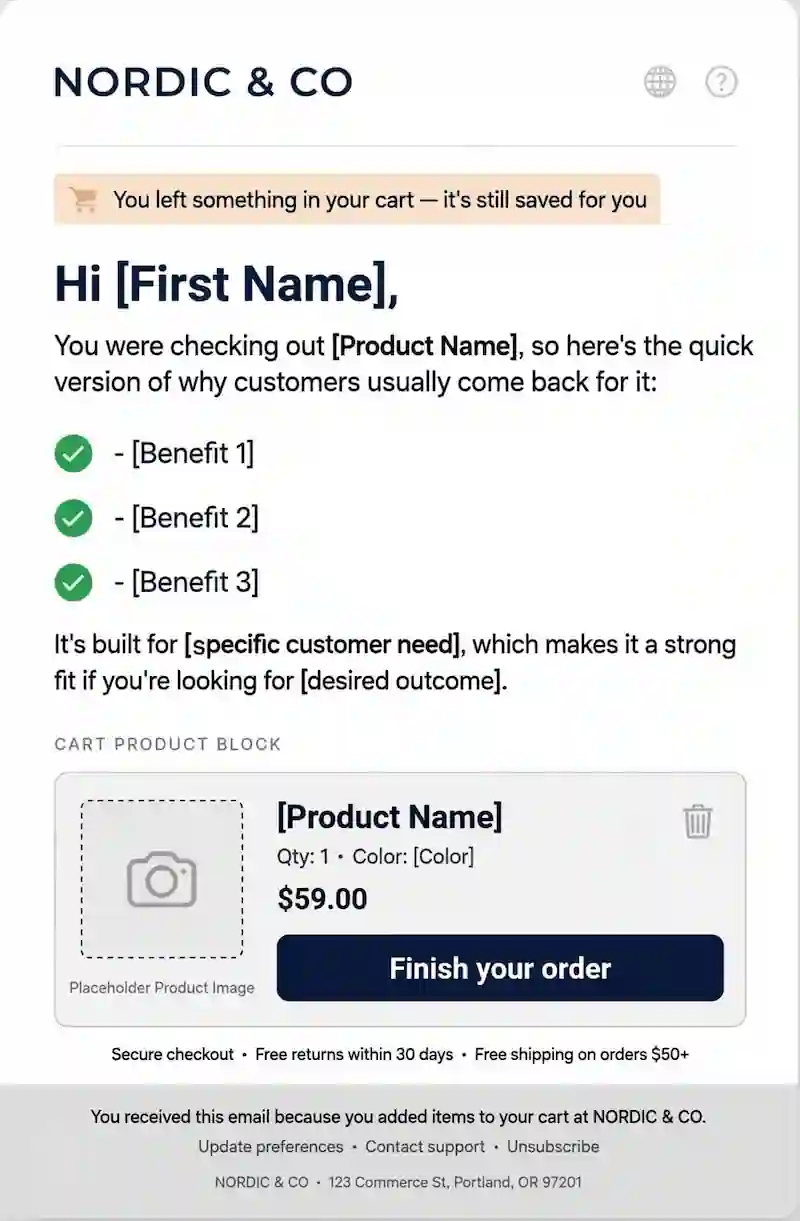
Template:
Hi [First Name],
You were checking out [Product Name], so here’s the quick version of why customers usually come back for it:
- [Benefit 1]
- [Benefit 2]
- [Benefit 3]
It’s built for [specific customer need], which makes it a strong fit if you’re looking for [desired outcome].
[Cart product block]
[Finish your order]
Still comparing options? Reply with any questions and we’ll point you in the right direction.
Best for: Products with meaningful features, materials, ingredients, specs, or clear use cases.
3. The Social Proof Email
Cart recovery emails often need to rebuild confidence. Reviews help when the shopper likes the product but still needs reassurance.
Subject line options:
- Customers are loving this
- See why shoppers come back for [Product Name]
- A few words from our customers
Template:
Hi [First Name],
Still thinking about your cart?
Here are a few things customers have said about [Product Name]:
“[Short review quote]”
“[Short review quote]”
People usually mention [common positive theme], which is why this has become one of our most popular picks.
[Cart product block]
[Complete checkout]
Your cart is still saved for now.
Best for: Apparel, beauty, wellness, home goods, accessories, food, and other trust-heavy categories.
4. The Objection-Handling Email
Use this when shoppers commonly hesitate over shipping, sizing, returns, quality, price, or delivery timing.
Subject line options:
- A few quick answers before you decide
- Wondering about shipping or returns?
- Need help with your order?
Template:
Hi [First Name],
Before you decide on your cart, here are a few quick answers that may help.
| Question | Answer |
|---|---|
| When will my order ship? | [Shipping answer] |
| What if it doesn’t fit or isn’t right? | [Return policy answer] |
| Is there a guarantee? | [Guarantee answer] |
[Cart product block]
[Return to your cart]
Still not sure? Reply here and we’ll help you figure it out.
Why it works: It answers buying questions before the shopper has to search for them.
5. The Incentive Email
Discounts can work well, but they should have a specific job. Consider one after the shopper has ignored the first reminder and only when your margin can support the offer.
Subject line options:
- A little extra reason to come back
- Take [X]% off your cart
- Your cart + a small thank you
Template:
Hi [First Name],
Your cart is still saved, and we added a little extra reason to come back.
Use code [CODE] for [offer] on your order.
[Cart product block]
[Apply code and checkout]
This offer expires on [date/time], so your code won’t be around forever.
Best for: First-time shoppers, competitive categories, seasonal pushes, and carts that haven’t converted after earlier reminders.
6. The Low-Stock Email
Scarcity only works when it’s honest. If inventory is actually limited, this can be one of the strongest cart recovery emails in the sequence.
Subject line options:
- Your cart item is almost gone
- Low stock on [Product Name]
- Quick heads up about your cart
Template:
Hi [First Name],
Quick heads up: [Product Name] is running low.
We saved your cart for now, but we can’t guarantee this item will still be available later.
[Cart product block]
[Complete your order]
If you were planning to grab it, now is the best time.
Best for: Limited inventory, seasonal products, popular SKUs, drops, and fast-moving sizes or colors.
7. The Plain-Text Founder Email
A less polished email can feel more personal. This works especially well for smaller ecommerce brands.
Subject line options:
- Quick question
- Can I help with anything?
- Saw you were checking out [Product Name]
Template:
Hi [First Name],
I saw you were checking out [Product Name] and wanted to ask if anything got in the way.
Was it shipping, sizing, price, timing, or something else?
You can return to your cart here if you’re still interested:
[Return to cart]
Either way, feel free to reply. I read the responses and they help us make the shopping experience better.
- [Founder Name]
Why it works: You may recover the sale, but you may also learn what needs fixing on the product page or checkout page.
How to Make Cart Recovery Emails Convert Better
Templates help, but the details decide how much revenue the flow ultimately recovers.
- Match the message to the cart value. A $35 cart and a $350 cart shouldn’t get the exact same message. Higher-value carts usually need more trust, support, and objection handling.
- Segment first-time shoppers and returning customers. New shoppers may need reviews and guarantees. Returning customers may respond better to convenience or loyalty messaging.
- Test your incentive timing. Try no discount in email 1, social proof in email 2, and an offer in email 3. Then compare revenue per recipient, conversion rate, and profit after discounts.
- Keep the CTA obvious. Use one main action: return to cart, finish checkout, or complete your order.
- Suppress recent buyers. If someone comes back and purchases, they shouldn’t keep receiving cart reminders.
Omnisend’s 2026 ecommerce marketing report analyzed messages sent through its platform by 150,000 brands in 2025. In that dataset, automations made up 2% of email sends but generated 30% of email revenue; automated emails earned $2.87 per send compared with $0.18 for scheduled campaigns.
Timing is a likely part of the advantage: behavior-based messages respond to interest the shopper has already shown.
Final Thoughts
The best cart recovery emails don’t feel complicated. They remind the shopper what they wanted, answer the question that may be holding them back, and make checkout easy.
Use the templates above as a base for a simple three-email sequence, then adjust the copy around your products, policies, margins, reviews, and buying cycle. The best version will sound like your brand and answer the questions your shoppers actually ask.
Cart abandonment is normal. A thoughtful follow-up gives interested shoppers an easy way back and gives your team another source of customer insight. Build the flow, test it against profit as well as attributed revenue, and improve it with evidence from your own store.